By Trust Build Windows and Doors ·
Walk along Haddon Avenue or Dalewood Avenue in Westdale on a cold January morning and plenty of front windows show the same thing: a thin ring of frost on the inside of the glass, right where the sash meets a hundred-year-old brick wall. Most homeowners assume that's just what old windows do in an Ontario winter. Sometimes it is. But on the solid masonry homes that make up much of Westdale's housing stock — 1920s and '30s two-storeys built close to McMaster, with double-brick exterior walls and no stud cavity behind the brick — that frost ring is often the first sign the frame itself, not just the glass, has given up.
That distinction matters here in a way it doesn't in Hamilton's newer subdivisions. Many houses built after the 1960s have brick veneer over a wood stud wall, and where the existing wood frame is still sound, square and dry, a straightforward insert replacement often works fine: the new window goes into that existing frame. Solid masonry doesn't give you that shortcut as often. If the original wood frame set into the brick opening has rotted, shifted, or was never insulated to begin with — common in homes built before modern codes — an insert just gets installed into a problem that's still there. That's what brick-to-brick installation is for, and our brick-to-brick vs. retrofit comparison lays out how the two methods differ.
What actually changes with brick-to-brick
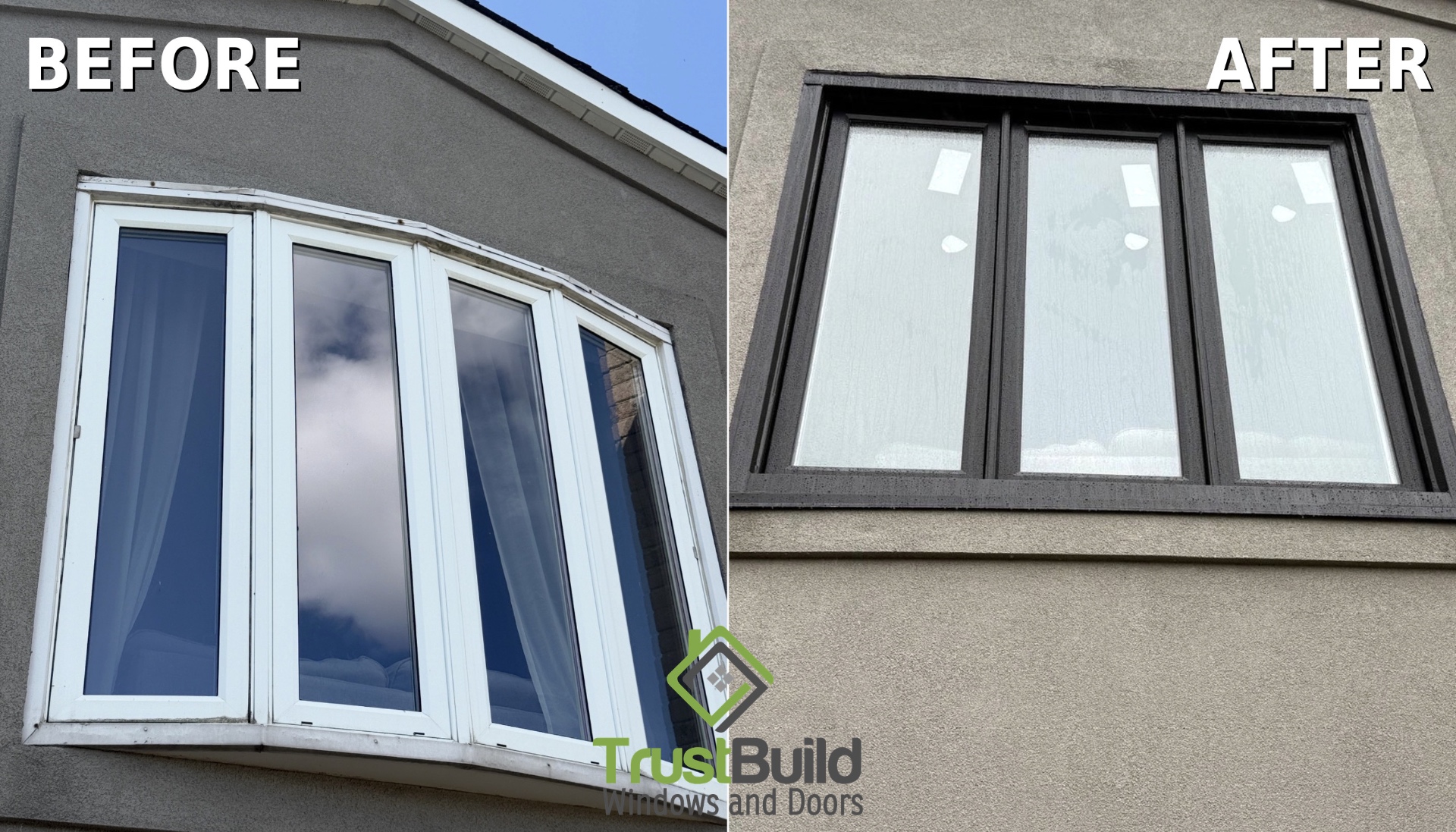
Instead of reusing the existing frame, a brick-to-brick replacement takes the window out completely — sash, frame, jambs, and casing — back to the rough opening. The opening gets vacuumed clean, any rotted wood in the opening gets addressed, a self-adhered Blueskin membrane goes in for moisture control, and the new vinyl window, with its brickmould or jamb extension, is shimmed, squared, secured to the framing, and sealed with low-expansion foam. Red tape goes over the foam, then new interior casing and exterior capping finish the opening. Our brick-to-brick installation process page walks through each step. It's a longer job per window, often most of a day instead of an hour or two, but for a wall that's been letting water or cold air track in behind the frame for decades, it's the only way to actually fix the problem instead of building around it.
I'd rather see a Westdale homeowner spend the extra time on the three or four openings that genuinely need it than do a full-house insert job that leaves the worst walls untouched. Not every window in one of these houses needs brick-to-brick — the south and west exposures, which take the brunt of wind-driven rain, tend to need it more than the sheltered north side.
Permits and timing in Hamilton
The City of Hamilton generally doesn't require a permit for a straight window swap, brick-to-brick included, as long as the rough opening size and the lintel above it aren't changing. That changes if a window is being enlarged, a bay or bow is replacing a flat window, or the lintel is deteriorated enough to need replacing — any of those means a call to the building division first. With Westdale's mix of century homes and the occasional heritage designation near the escarpment, it's worth checking before redesigning an opening, even when the window product itself needs no permit.
Winter doesn't rule the work out, but it changes the sequence. Where the sill also needs separate mortar repair, that repair needs the right curing temperature, so masonry touch-ups sometimes wait for a weather window or get done with cold-weather admixtures. The window install and interior finishing go ahead fine in cold weather; it's really just the exterior brick and mortar work that's climate-sensitive.
For a project like this, Energy Star-certified vinyl window options are available, which matters more in a solid masonry wall than most people expect — brick alone insulates poorly, so the window's own performance is doing more of the work than it would in a newer, better-insulated wall. Trust Build has replaced windows and doors in more than 8,700 Ontario homes, and 0% financing through Financeit is available for homeowners tackling several openings at once.