Zebra blinds solve a specific problem — light and privacy that adjusts through the day without switching between two separate window treatments. Here’s how to choose the right setup for a Markham home.
Zebra blinds have become one of the most requested window treatments in Markham over the past few years, and the reason is practical rather than trendy. Markham’s housing mix — dense condo developments in Downtown Markham and Unionville alongside larger detached homes in Cornell and Berczy Village — creates a wide range of light and privacy needs that a single fixed treatment (like curtains or standard blinds) struggles to solve well. Zebra blinds solve it with one mechanism instead of two.
What zebra blinds actually are
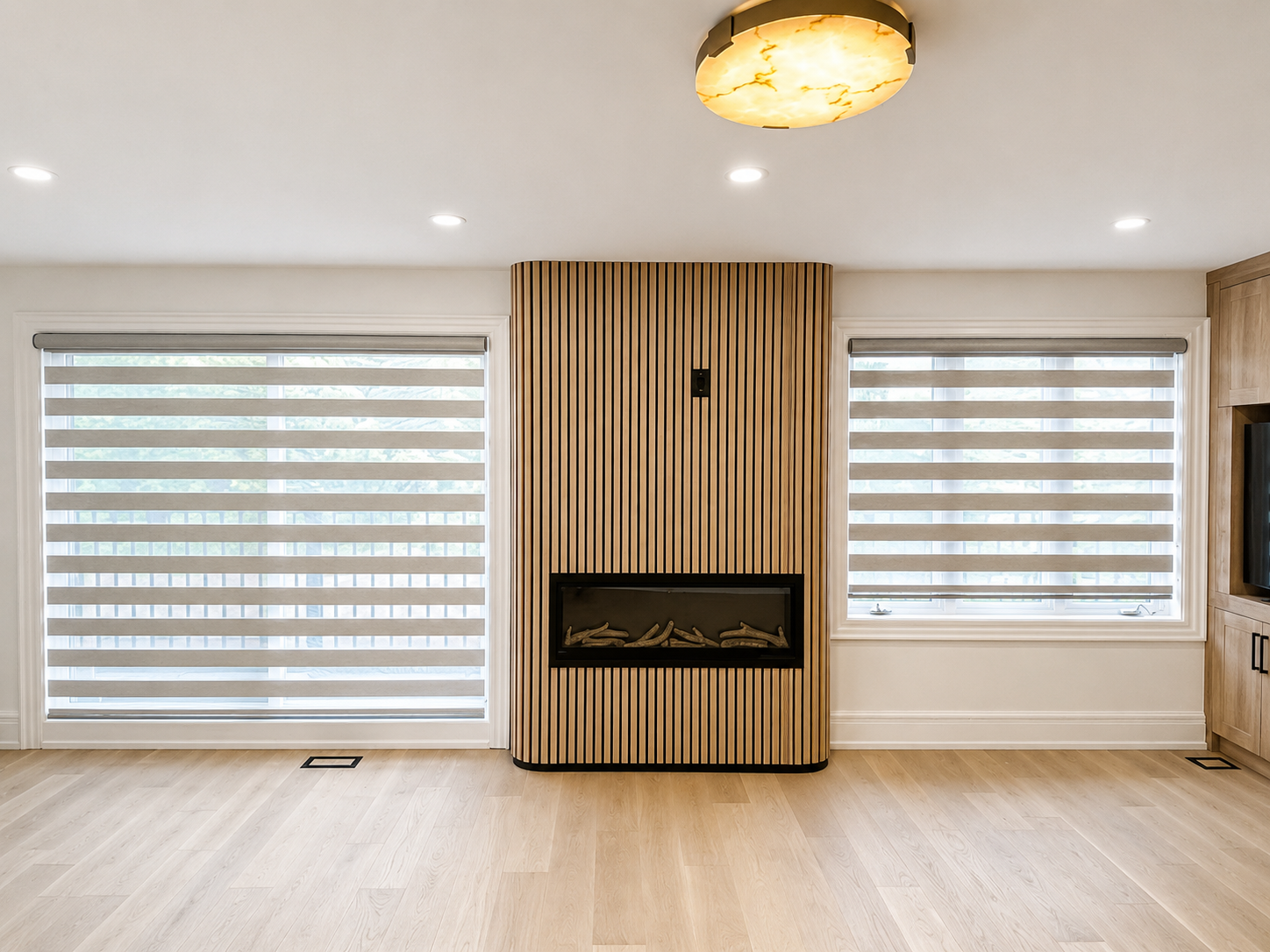
A zebra blind is a dual-layer roller shade made of alternating horizontal bands of sheer and solid fabric, mounted on a single roller. Rotating the mechanism slides the two layers relative to each other. Align the sheer bands and light filters through softly. Align the solid bands and the window closes to near-blackout privacy. One motion, one mechanism, a full range between fully open and fully private.
This matters more in a mixed-density market like Markham than in a market with more uniform housing. A condo on Enterprise Boulevard facing another building at close range has different privacy needs than a detached home in Cornell backing onto a ravine — and the same zebra blind mechanism serves both, just tuned differently by fabric opacity choice.
Choosing fabric opacity by room
Light-filtering fabric — best for living rooms and kitchens where you want daylight most of the day and only need full privacy occasionally. This is the most common choice for open-concept main floors in Markham’s newer detached builds.
Room-darkening fabric — the right call for bedrooms, especially east-facing rooms that catch early morning sun. Markham’s condo towers and townhome developments in Cornell and Wismer both see this requested heavily for primary bedrooms.
Blackout fabric — reserved for media rooms, nurseries, or shift workers who need to sleep during daylight hours. Less common as a whole-home choice, more common as a single-room upgrade.
Cordless vs. motorized
Standard continuous-loop chain operation is the lowest-cost option and works reliably for most windows. Two upgrades are worth considering for specific situations:
Cordless systems are the safer choice in homes with young children, since there’s no hanging chain or cord loop. This has become close to standard in new Markham builds where child safety codes are increasingly a buying consideration for young families in Wismer and Berczy Village.
Motorized zebra blinds suit Markham’s tech-forward buyer base well — the city consistently shows strong demand for smart-home upgrades. Motorization is particularly useful for hard-to-reach windows (over stairwells, above kitchen islands) and for large window walls in newer builds where manual operation of a wide single blind can be physically awkward.
What drives cost
Zebra blind pricing scales primarily with width, fabric grade, and whether you choose cordless or motorized operation. A cassette valance — the housing that conceals the roller mechanism for a cleaner finished look — adds a modest cost but is worth it on prominent windows like a living room picture window, less critical on a secondary bedroom window. See financing options if you’re outfitting a whole home at once.
Getting zebra blinds installed in Markham
Trust Build measures, supplies, and installs custom zebra blinds across Markham and the GTA — as a standalone project or alongside a window replacement. Browse the zebra blinds gallery or read our full guide to blinds.
Get a free quote: request a zebra blinds quote online. Or reach us at hello@trustbuildwindows.com · 1-800-563-1273.