
By Trust Build Windows and Doors ·
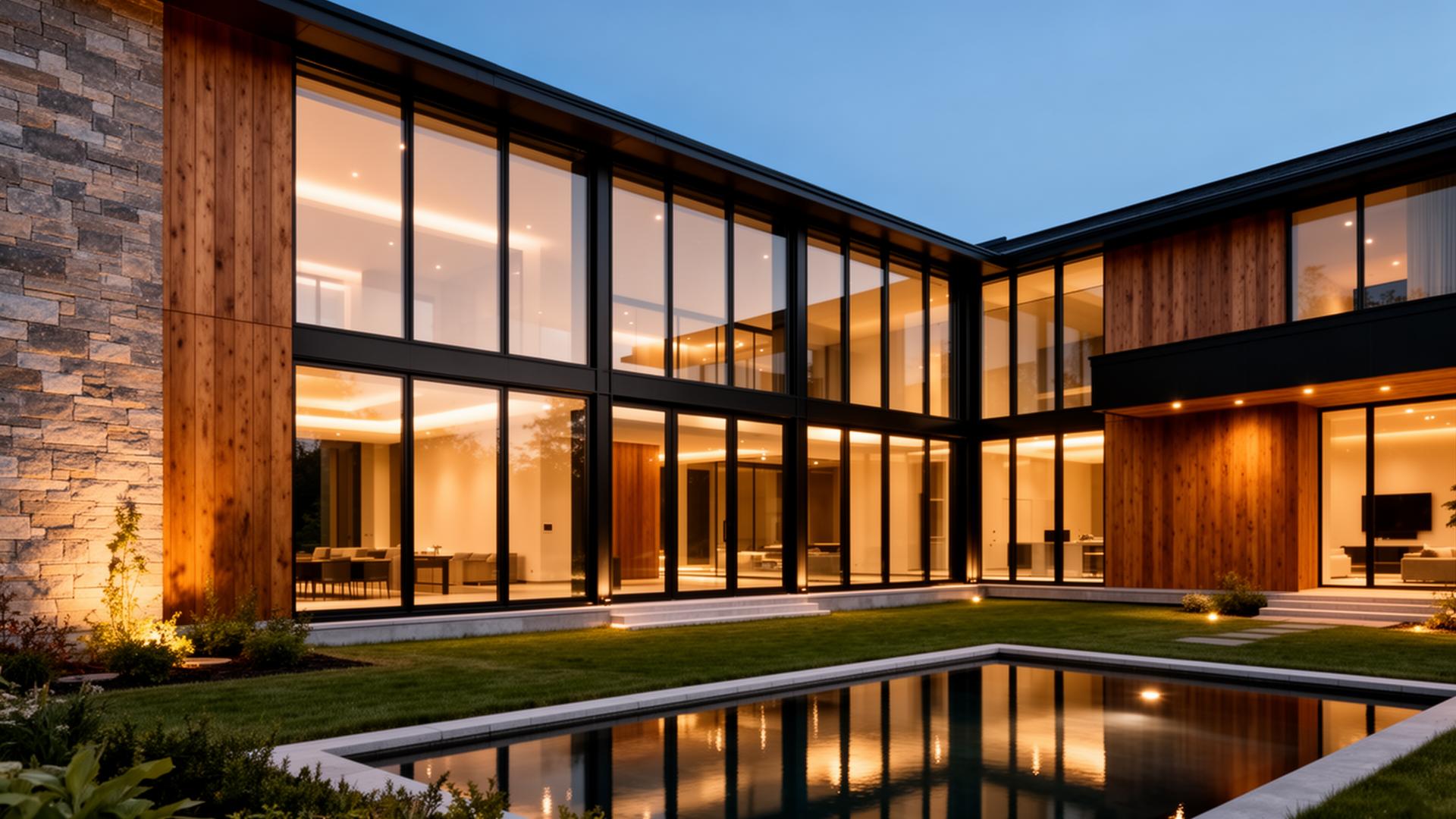
A homeowner near Bronte Harbour called us last month holding a set of architect's drawings for a rear addition — floor-to-ceiling glass facing the lake, slim black frames running the full width of the great room. The drawings called for aluminum. Every other window in her house, and every window in the three houses on either side of her, is vinyl. She wanted to know if the architect had made a mistake, or if she could just swap the spec to vinyl and save herself the headache.
She hadn't made a mistake. Aluminum keeps showing up in architect drawings for lakefront rebuilds in Bronte and along Oakville's shoreline because it's the frame material that can hold a large span of glass with a sightline thin enough to disappear. Vinyl frames need more bulk to stay rigid across a wide opening — fine for a bedroom window, less fine when the whole point of the room is an unbroken view of the water. Aluminum's strength-to-thickness ratio lets a fabricator build a frame that reads almost like a line instead of a box.
The catch, and it's a real one, is heat. Raw aluminum conducts cold straight through the frame, which on a windy January night off Lake Ontario is a genuine problem — Bronte's lakeshore properties take wind exposure that interior subdivisions a few streets back never see. An aluminum frame without a continuous thermal break will sweat and frost on the inside edge before the vinyl window two rooms over even notices the cold. That's not a reason to avoid aluminum; it's a reason to make sure the frame has a real thermal break engineered into the extrusion, not foam stuffed into the cavity afterward, and that the glazing behind it is doing its share of the work.
This is where the glass matters as much as the frame. A well-built aluminum window paired with a double- or triple-glazed, Energy Star-certified Low-E unit can hold its own against vinyl through a Southern Ontario winter — the frame's conductivity gets offset by what's happening between the panes. Skip that step, or buy an aluminum system built for a warmer climate and shipped north without changes, and you'll spend the next ten winters wiping condensation off the bottom rail every cold morning. We only install aluminum systems engineered for Ontario's freeze-thaw swings, never warm-climate product relabeled for a colder market.
Cost is the other honest conversation. Aluminum windows built to this standard run ahead of vinyl, sometimes well ahead on large fixed units or a sliding glass wall. For most Bronte homes — and most homes anywhere in Oakville — that premium isn't worth paying. If the project is a standard window replacement on a standard-sized opening, vinyl will outperform aluminum on both cost and thermal efficiency, full stop. Aluminum earns its place specifically on large-format openings where sightline and structural span are doing work vinyl physically can't do. We'll talk a client out of the more expensive option when it doesn't fit the project, because the alternative is a window wall that looks right in the rendering and underperforms for a decade.
Because the spec usually comes from an architect rather than a showroom visit, these projects tend to land on a homeowner's plate alongside the rest of a renovation budget — tile, millwork, the kitchen. 0% financing through Financeit over 12 months exists partly for that reason: these projects rarely show up in isolation. Installation isn't something to hand off to a general renovation crew either. It takes installers who have actually set large-format aluminum units against brick or stone veneer without compromising the air seal around them, which is part of why our own certified crews handle every one of these builds rather than subcontracting them out. Trust Build has installed Energy Star-certified windows for more than 8,700 homeowners across Ontario since 2016, and large-format aluminum systems get the same certified-installation standard as every vinyl window we put in.
If you're staring at a drawing set that calls for aluminum and wondering whether your contractor is right to want to swap it for something cheaper, get a second opinion before you sign off. The two materials aren't interchangeable once the opening gets large enough, and the wrong call either way shows up on your heating bill or in your view, not right away, but eventually.
Frequently asked questions
Can aluminum windows actually perform well in an Ontario winter, or is that just marketing?
Yes, but only with a continuous thermal break built into the frame extrusion and a proper double- or triple-glazed Low-E unit behind it. Aluminum without those two things will underperform badly on the coldest, windiest nights, especially on an exposed lakefront property.
How much more does a high-end aluminum window cost than vinyl in Oakville?
It depends heavily on size and configuration, but expect a noticeable premium over vinyl, especially on large fixed or sliding units. As a rough comparison, the jump from vinyl to a large aluminum system typically costs more than upgrading the same vinyl window from double to triple glazing.
Does every large-window or lakefront project in Bronte need aluminum?
No. Most standard-sized replacement windows, even on lakefront properties, are still better served by vinyl on both cost and efficiency. Aluminum earns its place on large-format openings where sightline and structural span matter more than anything else, not as a default upgrade.
How far in advance should a project like this be planned?
Custom aluminum units generally take longer to fabricate than stock vinyl windows, often several weeks before installation can even be scheduled. If an aluminum window wall is part of a larger renovation, it should be ordered well before the finishing stages of the project, not partway through.
Related reading: When a King City Great Room Called for Aluminum, Not Vinyl, How a 60x60 Window in Oakville Became a 60x72 View, One Cut at a Time, and Double Pane vs Triple Pane Glass: Is the Upgrade Worth It in Ontario?