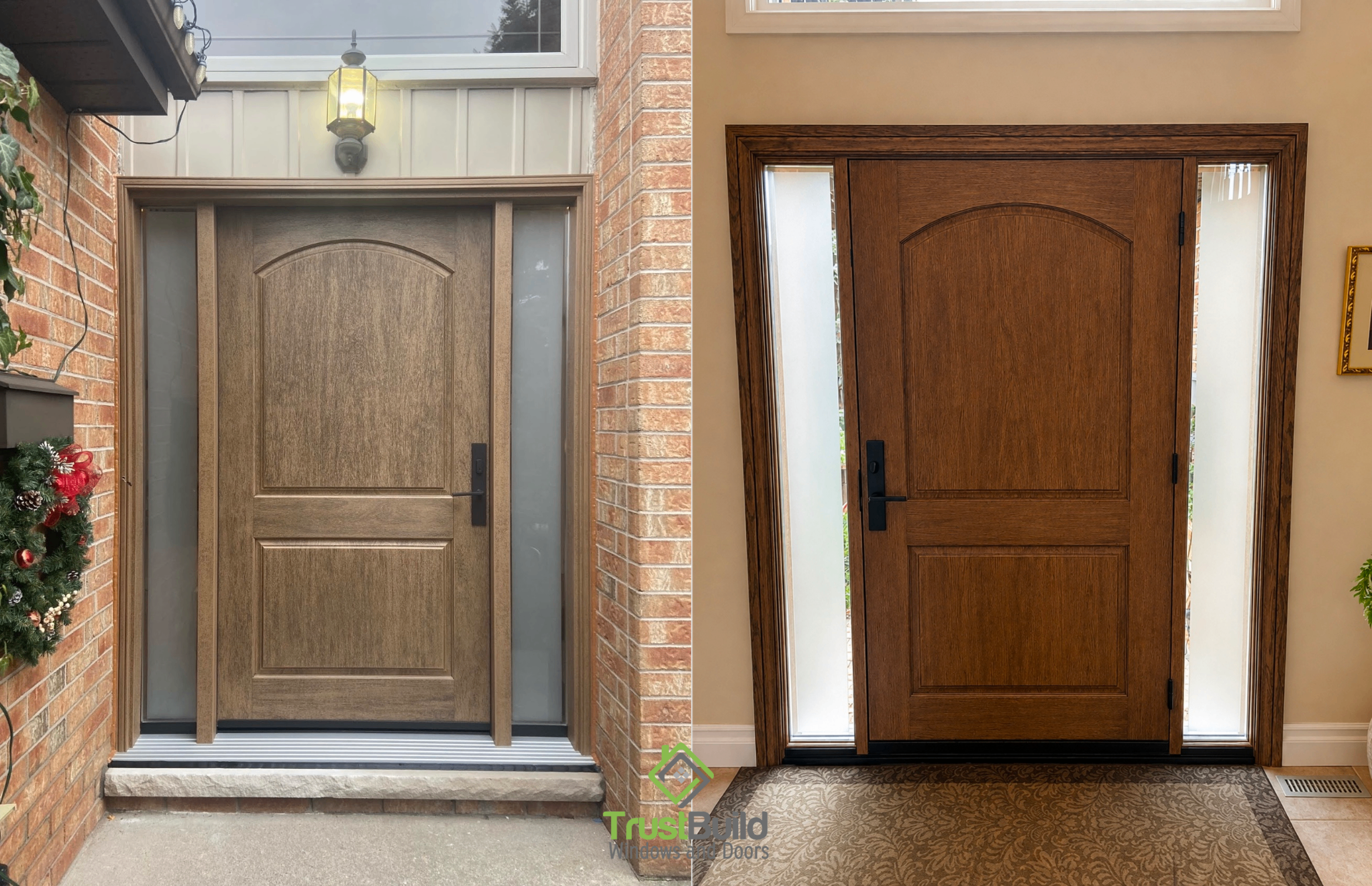
Most entry door projects treat the door and its surrounding trim as two separate decisions: pick a door finish, leave the interior casing whatever colour it already is. This 42-inch fiberglass door near Livingstone Street West in Barrie does the opposite. The interior casing is stained the exact same light tone as the door itself, so the frame and the slab read as one continuous piece rather than a door sitting inside someone else's trim.
Why matching casing is harder than matching paint
Paint colours are simple to match, mix the same code and you're done. Wood stain is different. Stain interacts with the grain, density, and finish of whatever it's applied to, which means the same stain formula can read slightly differently on a fiberglass door slab than it does on real wood casing. Getting both to land on the same visible tone takes deliberate finish-matching, not just ordering the same product name for both surfaces.
The sidelights: sandblasted with a clear edge
Both sidelights use a glass treatment called edge glass: the main body of the glass is sandblasted for privacy, while a clear border runs around the perimeter. That clear edge does real work beyond the look, it lets a visitor see there's daylight and depth beyond the door before they even reach it, while the sandblasted centre keeps the interior of the home private from the street. A fully clear sidelight gives up privacy entirely; a fully frosted one can feel closed off. Edge glass sits deliberately between the two.
Security: a Ferco Roma lock built for this door
The door is secured with a Ferco multipoint lock system using a Roma-style plate finish, matched to the door's overall hardware look rather than treated as an afterthought bolted on separately. A properly engaged multipoint lock secures the door at several points along its height from one motion of the handle, distributing security across the full frame instead of relying on a single strike point the way a standard deadbolt does.
Why the glass unit matters as much as the finish
A light-stain fiberglass door and its sidelights still need to perform thermally, not just look right. The glass units in the sidelights use Super Spacer® from Quanex/Edgetech, a foam-based, dual-seal warm-edge spacer rather than a conventional metal spacer at the edge of the glass. That matters directly at an entryway like this one where two full glass sidelights sit right beside the door, adding real glass area that would otherwise be a cold-edge liability in a Barrie winter.
Rebate note
Entry door replacements like this one may qualify for up to $100 per rough opening under the Home Renovation Savings™ program when you bundle two or more eligible upgrades. ENERGY STAR® certified products are required, and eligibility and approval depend on the current program requirements and administrator, with an energy assessment needed before work begins.